AI STRATEGY · 8-minute read
Most organizations are using AI to do yesterday’s work faster — and that’s exactly why adoption isn’t translating into value. Real AI workflow transformation means redesigning how work happens, not just automating the old version of it. This is a practical three-phase model for moving from AI tools that imitate old work to systems that create genuinely new value.
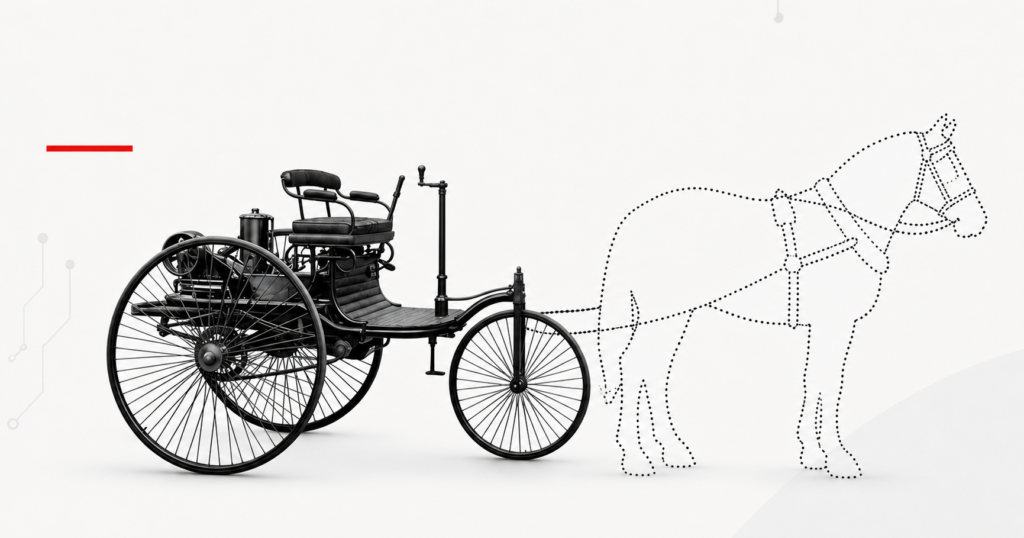
Most organizations are asking AI to do yesterday’s work faster.
They use a chatbot to draft an email, summarize a report, classify a document, or answer a customer question. The task becomes quicker, but the workflow, decision rights, roles, and customer experience remain largely unchanged.
This helps explain the gap between AI adoption and AI value. McKinsey’s November 2025 survey found that 88% of respondents said their organizations regularly used AI in at least one business function, yet nearly two-thirds had not begun scaling AI across the enterprise. Although 64% said AI was enabling innovation, only 39% reported enterprise-level EBIT impact.[1]
88%
Organizations reporting regular AI use in at least one function
~2/3
Still not scaling AI across the enterprise
21%
GenAI users reporting fundamental redesign of some workflows
39%
Reporting enterprise-level EBIT impact in late 2025
The problem is not necessarily the model. Often, the organization is still trying to fit a new capability into an old system.
The PivotPath three-phase disruption model
To see beyond isolated automation, PivotPath uses a practical three-phase model: Emergence, Evolution, and Maturity. It is not a prediction that every technology follows an identical path. It is a strategic lens for distinguishing a new tool from a new operating system.
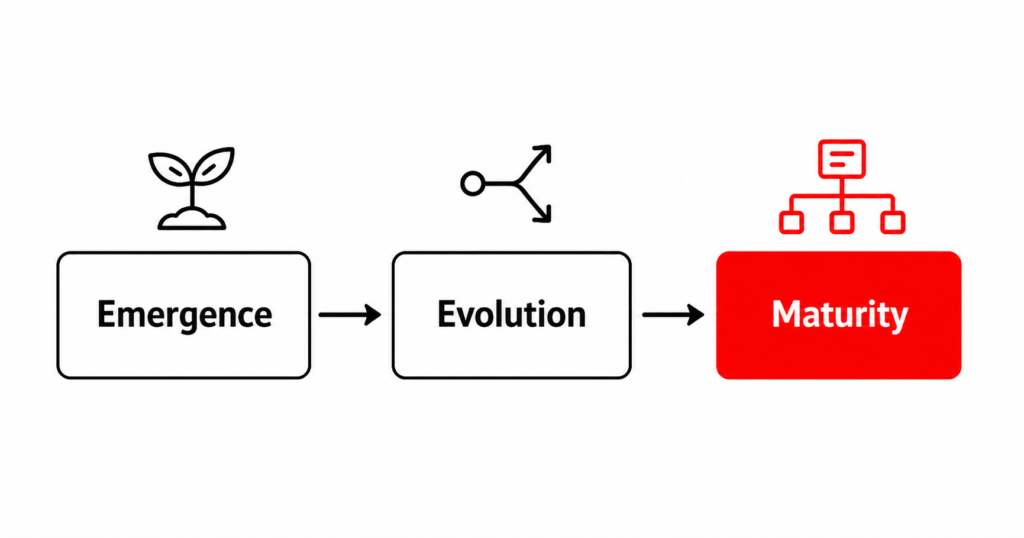
The PivotPath three-phase disruption model: technologies move from imitating the past to reorganizing the system around them.
Phase 1 — Emergence: the technology imitates the past
When a technology first arrives, it is imperfect, expensive, exciting, and difficult to place. To make it understandable, designers use familiar language and reproduce familiar activities.
Early automobiles were described as horseless carriages. Early websites resembled digital brochures. Online stores used shelves, baskets, and shopping carts. Today we call AI systems “copilots,” “assistants,” and “digital employees.”
This imitation is useful because it reduces uncertainty. It is also dangerous because it narrows imagination. When AI is shown performing tasks currently assigned to employees, the obvious forecast is that the same tasks will remain and the employees will disappear.
An emerging technology often mimics the past. Strategy begins when we stop confusing that mimicry with the future.
Email still carries the language of paper mail
Email is a clear example. We still use words such as mail, inbox, address, attachment, and copy. The official Internet Message Format standard explains that Cc means Carbon Copy, referring to copies once made on a typewriter with carbon paper.[3]
At first, email digitized the letter: one person wrote a message, addressed it, attached a document, and sent copies to others. If we had evaluated digital communication at this stage, we might have predicted faster correspondence, lower postal costs, and fewer paper-handling jobs.
Those predictions would have been partly correct — and strategically incomplete.
Phase 2 — Evolution: the technology standardizes and scales
In the evolution phase, the technology becomes more reliable and affordable. Standards emerge. It connects to other systems. Organizations stop running isolated experiments and begin embedding it in real work.
For AI, this means integration with customer relationship management platforms, enterprise systems, databases, email, document repositories, and internal policies. Governance becomes more formal. Employees learn where the system performs well and where it requires review.
Most enterprise AI adoption remains in this phase. In March 2025, McKinsey reported that 78% of surveyed organizations used AI in at least one business function, but only 21% of respondents using generative AI said their organization had fundamentally redesigned at least some workflows. Fewer than one in five said their organizations were tracking well-defined KPIs for generative AI solutions.[2]
By November 2025, 62% of respondents said their organizations were at least experimenting with AI agents, but the majority were still piloting rather than scaling. Adoption was spreading faster than operating-model change.[1]
Phase 3 — Maturity: the surrounding system changes
A technology reaches strategic maturity when it no longer appears as a separate tool. Workflows, customer expectations, roles, controls, and business models reorganize around the new capability.
Digital communication did not mature into a world of unlimited email. It became an ecosystem of messaging platforms, social networks, collaborative documents, video calls, online communities, live streaming, and digital publishing.
That ecosystem created forms of work that barely existed during email’s emergence: social media managers, community strategists, content creators, influencers, podcast producers, platform moderators, creator agencies, and search specialists.
Goldman Sachs Research estimated in 2023 that the creator economy included roughly 50 million creators and could grow from $250 billion to $480 billion by 2027. The forecast is not a final market count, but it illustrates the scale of economic activity enabled when digital communication moved beyond faster mail.[4]
The Three-Phase AI Disruption Model
From imitating the past to redesigning the future.
| Dimension | Phase 1 – EmergenceThe technology imitates the past | Phase 2 – EvolutionThe technology standardizes and scales | Phase 3 – MaturityThe surrounding system changes |
|---|---|---|---|
| Purpose | Make the new technology understandable and familiar | Make the technology reliable, integrated, and widely adopted | Redesign how work, value, and experiences are created |
| How it looks | Mimics existing tools, processes, and language | Embedded in workflows and connected to systems | Becomes the foundation of new workflows and models |
| Example (Digital Communication) | Email digitizes the letter (inbox, address, attachment, copy) | Email integrated with systems; policies, governance, and standards emerge | Ecosystem of messaging, social, collaboration, video, streaming, and digital publishing |
| Example (AI) | AI copilots and assistants perform tasks in existing ways | AI integrated with CRM, ERP, databases, and internal tools; pilots become programs | AI-native workflows, agents, and platforms reshape roles, customer experience, and models |
| What organizations focus on | Use cases and productivity gains | Adoption, integration, governance, and scale | Outcomes, customer value, ecosystems, and new models |
| Key risk if you stop here | Over-automation and disappointment | Pilot fatigue and limited enterprise impact | Competitors redesign the system around the technology |
| What success starts to look like | Faster execution of existing work | Consistent use, better quality, and measurable efficiency | New value, new experiences, and sustainable differentiation |
| Leading question | How can AI do this task faster? | How can we integrate AI across our workflows? | How do we redesign our system to create new value? |
The mature AI organization will not be a faster version of today’s company
Many AI strategies stop at a list of tasks: Which emails can be drafted? Which reports can be summarized? Which calls can be handled? Which positions can be reduced?
Those are emergence and evolution questions. The maturity question is different:
What barrier does AI remove, and how will the organization change when that barrier is gone?
Generative AI can reduce the expertise, time, and cost required to produce a first draft, search a knowledge base, translate content, analyze documents, generate software, or personalize an interaction. When a barrier falls, activity may expand rather than disappear.
Andrew Ng expressed this principle in relation to software: “As coding becomes easier, more people should code, not fewer.”[5]
The point is not that everyone becomes a professional engineer. It is that lower barriers allow more people to build prototypes, automate local problems, test ideas, and communicate precisely with machines.
When one thing becomes abundant, another becomes scarce
This is one of the most useful ways to anticipate the systemic phase of AI.
- When content becomes abundant, attention, originality, and trust become more valuable.
- When analysis becomes inexpensive, interpretation, data quality, and accountability become more valuable.
- When software becomes easier to create, architecture, security, maintenance, and product judgment become more valuable.
- When routine decisions become automated, exception handling and ethical judgment become more valuable.
- When AI can access many systems, permissions, governance, and cybersecurity become more important.
The World Economic Forum expects 39% of workers’ existing skills to be transformed or become outdated between 2025 and 2030. At the same time, employers continue to prioritize analytical thinking, resilience, leadership, creative thinking, and technology literacy.[6]
A finance department example
Consider how the three phases might unfold in finance.
Emergence
Employees use AI to explain formulas, draft variance comments, classify expenses, and summarize invoices. The existing process becomes slightly faster.
Evolution
AI connects to accounting software, bank feeds, procurement systems, policies, and reporting tools. It reconciles transactions, flags anomalies, prepares recurring reports, and routes unusual cases to people.
Maturity
Financial information becomes continuous rather than periodic. Managers interact with a living model that detects changes, simulates scenarios, explains drivers, and connects financial consequences to operational decisions.
The organization may need fewer people manually entering or reconciling data. But it may need more financial strategists, data stewards, control designers, AI assurance specialists, cybersecurity capability, and people who can challenge assumptions and translate model outputs into decisions.
The mature finance function is not simply the old department with fewer bookkeepers. Its role in the organization has changed.
Six questions for designing the systemic phase of AI
1. Which barrier limits value today?
Look for delays, inaccessible expertise, fragmented information, expensive analysis, or customer needs the organization cannot currently serve.
2. What becomes possible when that barrier falls?
Imagine a new service, decision, experience, or business model — not only a faster task.
3. Where will the bottleneck move?
Faster production may create pressure in review, integration, approval, trust, security, or customer attention.
4. Which capabilities become more valuable?
Name the specific judgment, relationship, domain expertise, system design, or risk capability that complements AI.
5. What new responsibilities must be assigned?
Decide who monitors performance, investigates errors, approves data access, manages vendors, and remains accountable for outcomes.
6. Which future does this investment pull us toward?
Evaluate whether the tool reinforces an old process, merely removes labour, or creates a stronger operating model and new customer value.
Frequently asked questions
What is AI workflow transformation?
AI workflow transformation means redesigning an end-to-end process around AI capabilities instead of adding an AI feature to one isolated task. It includes roles, decisions, data flows, controls, handoffs, measures, and customer outcomes.
Why do AI pilots fail to scale?
Common reasons include poor data access, weak integration, unclear ownership, no adoption plan, missing KPIs, insufficient trust, and failure to redesign the workflow. McKinsey found workflow redesign to be the tested organizational attribute with the largest effect on reported EBIT impact from generative AI.[2]
Does mature AI adoption mean fewer employees?
It can reduce staffing needs in some activities, but maturity is not defined by headcount. It is defined by systemic change: new workflows, better decisions, new responsibilities, new value, and a different relationship between people and technology.
Do not automate your way into the past
The first stage of a new technology makes the old world faster. The mature stage changes what the world is organized to do.
AI strategy should therefore begin with automation but not end there. Leaders must look beyond the task the model can perform today and imagine the organization that becomes possible when intelligence, creation, and analysis are easier to access.
The companies that create lasting value from AI will not simply use better tools. They will redesign the system around them.
Key takeaways
- Most AI adoption is stuck in the emergence phase: using AI to do yesterday’s work faster, which explains the gap between adoption and business impact.
- Strategic value arrives at maturity, when workflows, roles, and operating models reorganize around the new capability — not when tasks simply speed up.
- Start with the barrier AI removes, ask what becomes abundant and what becomes scarce, and redesign the system — the six questions in this article are the working checklist.
Sources and further reading
The numbered citations in the article link to the sources below. Access dates: July 24, 2026.
- McKinsey & Company. The state of AI in 2025: Agents, innovation, and transformation (November 5, 2025).
- McKinsey & Company. The state of AI: How organizations are rewiring to capture value (March 12, 2025).
- RFC Editor. RFC 5322: Internet Message Format (October 2008).
- Goldman Sachs Research. The creator economy could approach half-a-trillion dollars by 2027 (April 19, 2023).
- Andrew Ng. As coding becomes easier, more people should code, not fewer (March 2025).
- World Economic Forum. The Future of Jobs Report 2025 — Digest (January 2025).

